How to Make Your Voice Count on Rethinking I-94
By Felicia Perry, SUPC Board Chair
A Guide for Summit-University Neighbors
A formal public comment period for Rethinking I-94 is now open from January 6 through March 23, 2026. During this time frame, community members can review and comment on key planning documents that will shape the next phase of decisions about the I-94 corridor.
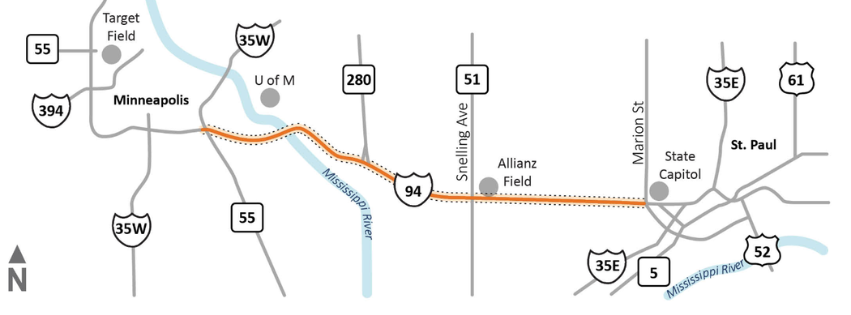
Rethinking I-94 is a long-term planning process led by the Minnesota Department of Transportation (MnDOT) and the Federal Highway Administration. It is the first comprehensive review of I-94 through the Twin Cities since the highway was built in the 1960s, and it will influence transportation, land use, environmental health, and neighborhood connections for decades to come.
While I-94 runs just outside the Summit-University district boundary, decisions made through this process directly affect our community — including traffic patterns, air quality, safety, access to businesses and services, and future redevelopment near our neighborhood and the historic Rondo area.
This guide is here to help Summit-University neighbors understand the process and feel confident submitting a public comment. You do not need to be a planner, engineer, or policy expert to submit a meaningful comment. Everyday experiences, observations, and concerns help shape what is studied, what alternatives are considered, and what protections or changes are required.
Public Comment = Your Chance to Shape the Project
Public comment is how community voices become part of official decision-making.
You don’t need technical language.
You don’t need to read every page.
You don’t need to have the “perfect” words.
What matters most is:
What you see
What you experience
What your community needs
Why it matters:
Your comment becomes part of the public record, and agencies are required to review and respond to it.
Key Terms — Explained in Plain Language
Environmental Document
A report that explains what a project (like rebuilding or changing I-94) could do to people, homes, businesses, traffic, air quality, and the environment.
Public Comment
Your opportunity to share how the project affects your neighborhood — by email, letter, online form, or speaking at a meeting.
NEPA (National Environmental Policy Act)
A federal law that requires big projects to study their impacts and give the public a chance to weigh in.
Scoping
The early “what should we study?” stage.
This is when you can say:
“Don’t forget health impacts.”
“Make sure small businesses are considered.”
“Study alternatives that reconnect neighborhoods.”
EIS (Environmental Impact Statement)
A very detailed study of big impacts and big projects.
Think of it as the full book.
Draft EIS
The rough draft of that book — shared so the public can comment before anything is final.
EA (Environmental Assessment)
A shorter study used for smaller or less complex projects.
Mitigation
Ways to reduce harm or fix problems caused by the project — like improving safety, reducing pollution, or addressing noise.
Substantive Comment
A comment that explains:
What you’re concerned about
Why it matters
How it affects your neighborhood
What you want changed
These comments carry real weight and must be considered.
When Your Voice Matters Most
There are two key moments to submit comments:
1. Early Stage (Scoping)
This is when you can say:
“This is what you MUST study.”
“This is harm we already experience.”
“These are alternatives we want considered.”
2. When Draft Studies Are Released
This is when you can say:
“Here’s what was missed.”
“This doesn’t fix the problem.”
“Here’s how this helps or hurts our community.”
“Here are solutions that would work better.”
How to Submit a Comment
You can:
Write an email or letter
Fill out an online form
Speak at a public meeting
Handwrite a comment
Submit comments as an individual or with others
Anything submitted in writing becomes part of the official record.
An Easy Way to Write a Strong Comment
You can use this simple four-step format:
1. What part of the project affects you?
(traffic, noise, pollution, walking safety, business access, etc.)
2. What is your concern or idea?
Focus on one issue at a time.
3. Why does this matter to you or your community?
Think about health, safety, access, culture, or economics.
4. What do you want MnDOT to do?
Ask for more study, suggest a solution, or request mitigation.
This turns a “substantive comment” into something anyone can do.
Use Real, Local Examples
Concrete examples are powerful.
Instead of:
“Traffic impacts should be analyzed.”
Try:
“Cars speed through Selby and Victoria after leaving the freeway. Please study pedestrian safety and protections for kids and elders crossing the street.”
Your everyday experience is important data.
Remember: This Is Community Power
Public comments are not just venting.
They shape what gets studied
They influence which alternatives move forward
Agencies must respond to them
They become part of the legal record
Your voice matters, especially when many neighbors speak up together.
Want More Support?
SUPC will continue sharing information, resources, and opportunities to help Summit-University residents participate in this process.
Together, we can help ensure decisions about I-94 reflect the needs, experiences, and priorities of our community.