The Dale Street Redesign Is a Winner: A Safer Street for Saint Paul
The Dale Street Redesign Is a Winner: A Safer Street for Saint Paul
By Jason Shiggs, SUPC Community Improvement and Safety Committee Chair
Let me just say it: Ramsey County’s Dale Street redesign is a winner. They hit the mark on this one.
As someone who cares about the future of Saint Paul and the safety of our neighborhoods, I’m thrilled with what I’m seeing along Dale Street. The project addresses something residents have been asking for all along: slow down the traffic and make it easier for people to move safely through our neighborhood.
We want our neighborhood to come together. We want children at Benjamin Mays and Capitol Hill to be able to walk safely to nearby parks. We want students at Barack and Michelle Obama Elementary to move between parts of the neighborhood without having to contend with fast-moving traffic. In other words, we want Dale Street to be more than a road for cars. We want it to be a street that connects our community.
And Ramsey County has made terrific progress toward that goal.
The Pedestrian Islands Are the Pièce de Résistance
Over the last couple of days, I’ve watched the pedestrian islands go in, and I have to say they are the pièce de résistance of this redesign.
Consider what happens when you’re driving toward one of these islands, particularly the one closest to I-94. The roadway narrows, and the island is positioned at an angle that requires you to adjust your steering to navigate around it. You can’t simply barrel down the street at the same speed you might have driven before. You have to pay attention, adjust your path, and slow down. Before you know it, you’re traveling at less than 10 miles per hour and approaching an intersection where you have to stop or respond to the traffic controls.
That’s traffic calming in action.
Of course, the islands serve a purpose beyond slowing down drivers. They provide pedestrians with a protected place to pause while crossing the street, allowing people to cross one direction of traffic at a time rather than attempting to cross the entire road in one go. Think about a child walking to a park, an older adult crossing the street, or someone who simply needs a little more time to get across. Having a protected refuge in the middle of the road can make a meaningful difference.
These improvements won’t eliminate every danger, and we’ll need to see how the street performs over time. But the design is a welcome step toward making Dale Street a safer place for everyone.
Ramsey County Listened to the Community
One of the things I appreciate most about this project is that the county took the time to hear from the people who actually use the street. Ramsey County began community engagement in 2023, and residents had opportunities to share their concerns and ideas through public meetings, online surveys, interactive maps, stakeholder outreach, and other community events. I remember the outreach efforts, including events at the Jazz Fest and the Martin Luther King Recreation Center. People were trying to communicate a fairly straightforward message: we need traffic-calming measures, safer pedestrian crossings, and a street that works better for the neighborhood.
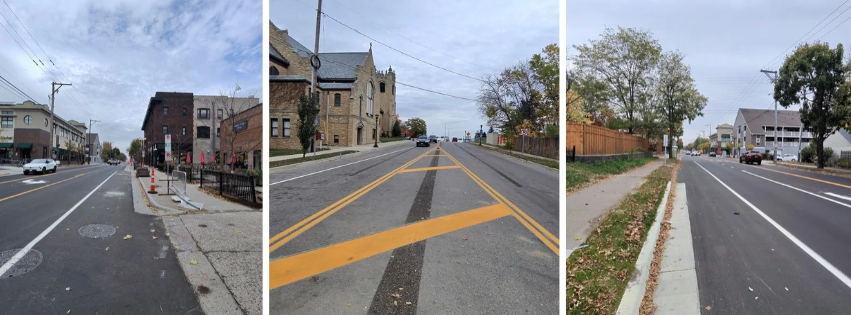
The county’s own project materials identify pedestrian safety, crossing Dale Street, roadway design, and bicycle infrastructure among the issues raised during community engagement. The final project reflects that input: a four-to-three-lane conversion, new pavement and road markings, curb replacements in selected locations, and new or upgraded traffic signals.
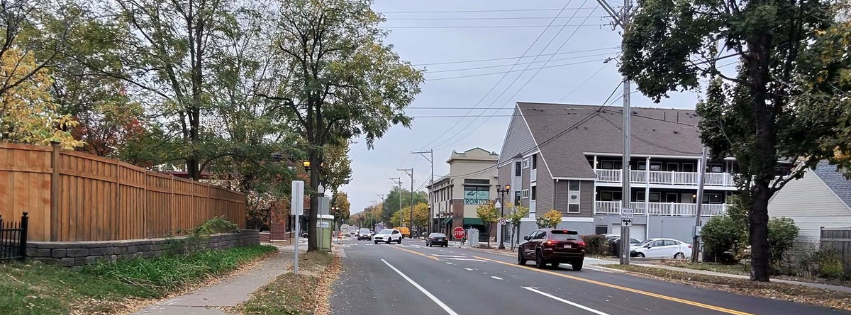
The lane conversion is especially important. By changing the roadway from four travel lanes to three, with a center turn lane, the design changes how vehicles move along the corridor while creating opportunities to improve safety. This isn’t simply a matter of putting down fresh asphalt and calling it a day. It’s an effort to rethink how the street functions. And that deserves recognition.
The Bump-Outs Make a Difference, Too
I’d also like to give a shout-out to the curb extensions, commonly known as bump-outs, installed at key intersections. The improvements at Selby and Dale and at Marshall and Dale are particularly welcome. Bump-outs extend the sidewalk into the parking lane at intersections, shortening the distance pedestrians have to cross and potentially improving visibility between drivers and people on foot.
These might seem like relatively small changes, but that’s precisely the point. Sometimes the difference between a street that feels hostile to pedestrians and one that feels comfortable comes down to a series of thoughtful design decisions.
I do wish they’d been able to put a bump-out at Dayton and Dale, too. Perhaps there were engineering, funding, or other constraints that made it impractical. I don’t know. But we’ll take what we can get, and I’m happy with the direction we’re moving. The important thing is that pedestrian safety is becoming part of the conversation about how we design our streets.
Saint Paul Is Never Going to Be Woodbury—and That’s a Good Thing
Here’s where I’ll go off on a bit of a tangent. I often say that Saint Paul is never going to be Woodbury. And you know what? We shouldn’t try to make it Woodbury.
Suburban development often revolves around cars. You drive 40 miles per hour or faster along major roads, turn into a shopping center, park, do your shopping, and drive home. That model serves a purpose, but Saint Paul has different strengths.
We have established neighborhoods, local businesses, parks, schools, historic streets, and destinations that are often close to one another. We have the potential to create places where people can walk down the street, stop into a neighborhood business, meet a friend, or take their children to a nearby park. But we have to design our streets to support that kind of life.
It’s difficult to encourage people to walk to local businesses when they have to cross wide roads filled with fast-moving traffic. It’s difficult to build a strong neighborhood identity when a street functions primarily as a way for cars to move through the area as quickly as possible.
If we want Saint Paul to thrive, we need to lean into what makes us different. That means creating streets where traffic moves at neighborhood-friendly speeds—closer to 20 miles per hour where appropriate—and where walking and biking are practical options rather than afterthoughts. It means supporting small businesses that benefit when people feel comfortable spending time in their neighborhoods. And it means recognizing that streets aren’t just transportation infrastructure. They’re part of the public realm. They shape how we experience our city and interact with one another.
Our economic future depends, in part, on building neighborhoods that people actually want to spend time in. We cannot compete with every suburban infrastructure model, nor should we try. We have to go our own way and build on our strengths. When Saint Paul embraces its identity as a city of walkable neighborhoods and thriving local businesses, I believe we’ll have a much brighter future.
What About Bicycles?
Now, to be clear, Dale Street isn’t a street designed specifically for bicycles. I still wouldn’t recommend it as a preferred cycling route. But if you happen to find yourself riding along Dale Street today, the experience is dramatically better than it was before.
Previously, cyclists had very little room to maneuver while cars traveled past at uncomfortable speeds. With the redesigned roadway, the new layout gives cyclists more room to work with in places, and the slower traffic makes a real difference in how the street feels. From my perspective, it’s a night-and-day improvement.
That doesn’t mean Dale Street has become a fully bicycle-friendly street, and I don’t want to overstate what the project accomplishes. Dedicated bicycle infrastructure would be a separate consideration. Still, improving the conditions for people who are already riding their bikes along the corridor is a welcome benefit. And that’s another reason to appreciate a project that considers more than just the movement of cars.
A Win for the Neighborhood
Ultimately, what I love about the Dale Street redesign is that it represents a better approach to street design. Ramsey County had an opportunity to improve an existing roadway, and the project addressed both infrastructure needs and safety concerns. The county engaged with residents, considered their feedback, and incorporated meaningful changes into the design.
The result is a street that, in my experience, feels more appropriate for a neighborhood where people live, walk, go to school, visit parks, and support local businesses. Will the redesign solve every traffic problem? Of course not. We’ll need to see how drivers adapt, how the intersections function, and what the safety data show over time. But we shouldn’t let the pursuit of perfection prevent us from recognizing meaningful progress.
I’ve watched the improvements take shape along Dale Street, all the way down toward Grand Avenue, and I think the results are terrific. The pedestrian islands, the lane conversion, the improved crossings, and the other changes are moving us in the right direction. Most importantly, they help reinforce an idea that should guide transportation planning throughout Saint Paul: our streets should serve the people who live here, not just the cars passing through.
Dale Street is a win for pedestrians, a win for the neighborhood, and a step toward the kind of Saint Paul I want to live in.
Let’s build on it.
Source: Ramsey County’s official Dale Street Safety Conversion project page.